
The Race Against Big Tech:
Building an AI Design Assistant Before Figma Did
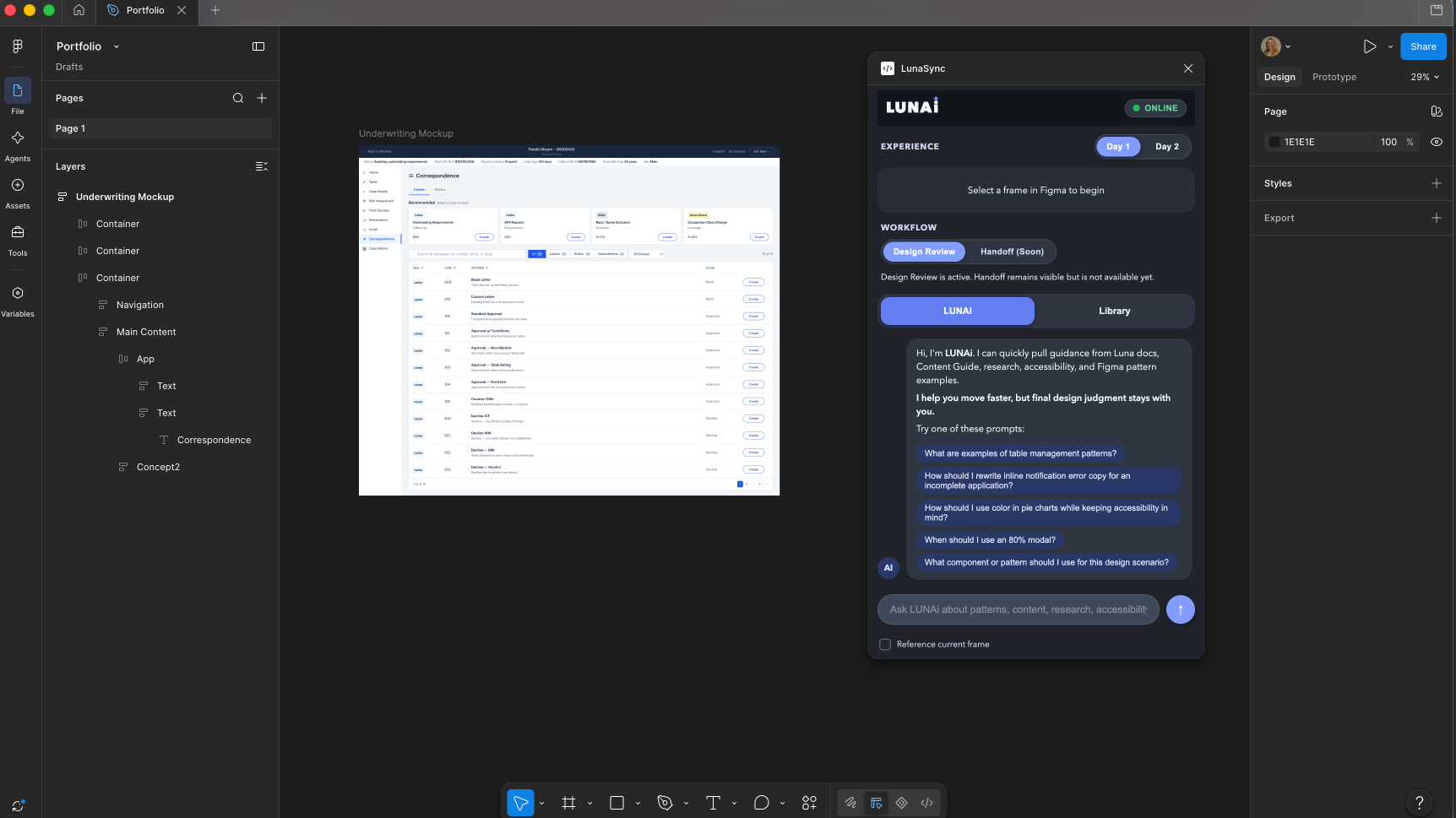
The Challenge
Our design knowledge was everywhere.
Luna design system guidance, content standards, and established patterns lived across multiple websites, files, and team conversations. Finding the right answer often meant leaving Figma and searching through documentation, or asking around for context.
In a world increasingly powered by AI, that felt like an unnecessary barrier.
What if designers could get the answers they needed without ever leaving the canvas?
That question became LUNAi, an AI-powered Figma assistant designed to surface design system knowledge directly within the workflow.
What started as a way to answer questions evolved into a tool that could generate UI, provide guidance, and help designers stay aligned with Luna while moving faster.
This case study follows the evolution of that idea, the challenges of building AI-powered experiences in a rapidly changing landscape, and how LUNAi adapted as tools like GitHub Copilot and Figma AI reshaped what was possible.
Th
March 2026: Take Your Mark
LUNAi didn't begin as an AI assistant.
The original concept was a design review companion, helping designers identify issues and leave annotations directly on the canvas before sharing work with teammates. As I explored the problem, I realized designers spent just as much time searching for information as they did reviewing designs. Rather than tackling both challenges at once, I decided to start smaller and focus on an MVP: making design knowledge easier to access, while keeping the vision of AI-powered design reviews in mind.
The first version centered around two experiences:
Ask LUNAi
A conversational interface where designers could ask questions about Luna, content guidelines, and design patterns directly within Figma.
Smart Search
Easier way to find the source of truth, linking designers directly to the relevant documentation instead of searching across multiple resources.
Rather than solving every problem at once, I wanted to validate a simple hypothesis:
If design knowledge was available directly in the canvas, would designers use it?
Get Set, Go... Find an LLM
With the MVP taking shape, it was time to tackle what I assumed would be the easy part: adding intelligence.
Around this time, I was invited to join an internal AI Design Lab, where I presented LUNAi to designers, design leaders, and others exploring AI across the company. The response was overwhelmingly positive. People immediately saw the value of bringing design system knowledge directly into the canvas.
There was just one problem…No one had a clear answer for how to get an approved LLM into the experience.
I explored several options, including local LLMs, and connected with an engineer after hearing him discuss them during a company-wide AI conversation. His feedback was honest: the approach I'd been pursuing would require months of approvals, funding, and stakeholder buy-in, if it got approved at all.
By then, AI capabilities were advancing so quickly that I suspected a similar solution would already exist. I wasn't interested in waiting for someone else to build the idea.
It was time to adapt. The goal had never been to use a specific technology. The goal was to make design knowledge easier to access. If the original path wasn't realistic, I needed to find another one.
That realization led to the next evolution of LUNAi.
Rerouting
After moving away from the original LLM approach, I started exploring the tools already available to me. Around the same time, my manager challenged me to think about how designers could work beyond the Figma canvas, which pushed me to rethink what LUNAi could become.
Using VS Code and GitHub Copilot, I reorganized Luna knowledge into a structure that was easier for both AI and humans to navigate. Engineering resources, design knowledge, and UI definitions each had their own space, with YAML helping make the system more approachable for designers without coding experience.
My goal was simple: create a repeatable setup where designers could use a single prompt to generate prototypes, explore interactions, and reference Luna guidance without needing to understand the underlying technology.
To test the concept, I asked a designer with little coding experience to use the workflow on their own. Using a prompt connected to SharePoint documentation, markdown knowledge files, and the YAML structure, they were able to navigate the system and generate useful outputs with minimal guidance.
The biggest challenge was generating YAML from scratch, but the feedback was clear: it felt far more approachable than working directly with HTML or JavaScript.
The experiment reinforced an important lesson: the value wasn't the AI itself. It was organizing knowledge in a way that made it easy to access and use.
From the Back of the Pack comes Figma Agent!
While I was iterating on LUNAi, the AI landscape wasn't standing still.
Figma had already introduced Agents, but the experience still felt limited. Then came significant improvements, along with Skills, making it possible to ground agents with domain-specific knowledge and create more capable workflows.
Suddenly, many of the ideas that had inspired LUNAi from the beginning felt within reach.
Instead of simply answering questions, the experience could now:
Generate Luna-compliant UI
Answer design system questions
Surface content guidance
Annotate designs with recommendations
Create new frames grounded in established patterns
What started as a chatbot was evolving into something much closer to an intelligent design companion.
The race had changed. The challenge was no longer figuring out how to bring AI into the workflow. The challenge was figuring out how to make AI useful by giving it the right knowledge.
Photo Finish
Looking back, LUNAi changed several times before reaching its current form.
It started as a design review tool, evolved into a design system assistant, became a knowledge layer for GitHub Copilot, and eventually found new opportunities through Figma's evolving AI capabilities.
The biggest lesson wasn't about plugins, AI, or prompt engineering.
It was about adaptability.
Every major breakthrough came from rethinking the solution while staying focused on the same problem: helping designers find answers faster and make better decisions without leaving their workflow.
The technology may have changed, but the goal stayed the same.
LUNAi began as an attempt to bring design knowledge into the canvas. Today, it's taught me that the most valuable AI experiences aren't defined by the model behind them, but by the quality of the knowledge they make accessible.
A Fair, Fast Race
Building LUNAi taught me that, in the age of AI, the finish line is always moving. Staying effective means continually learning, testing, and rethinking what is possible.
It also requires judgment. AI-generated work should be reviewed, validated, and never trusted blindly, especially when accessibility, content, and design-system standards are involved.
LUNAi is not intended to replace designers. It helps reduce repetitive tasks and small interruptions so designers can focus on larger, more meaningful problems. The goal remains the same: faster workflows, stronger Luna outcomes, and better experiences for users.